David Lander
Final post
Perception and Mortality
While perusing the archives of our class blog, the thread that reverberated loudest to me was that of the human attempt at perceiving the metaphysical place one occupies and its frequent incongruence with the concept of mortality. While this thread could be considered a broad poetic theme incapable of exhaustion, the purpose of my final post is to compare and contrast the methods with which three diverse poets attend to the problem of perception versus mortality, specifically with regards to nature imagery and the contemplation of death. Poets have historically employed this kind of idealistic juxtaposition either to emphasize the vastness and beauty of the natural world or to construct a frame from which the reader may more easily understand the role of humanity in the world. I have selected the following poems which exemplify most concisely the correlation between perception and mortality: Spenser’s “Sonnet 75,” Shelley’s “The Sensitive Plant,” and Rekdal’s “A Small, Soul-Colored Thing.”
Spenser’s “Sonnet 75” approaches the subject of mortality through the description of impossible longing between two lovers. Often in poems that address the inevitability of death, we find some natural phenomenon that represents time; Spenser employs the images of “waves,” “wash[ing],” and “tide.” The (primary) speaker of the sonnet naively attempts to write his lover’s name in the sand so that her “virtues rare” might not be forgotten. To contradict the speaker’s poetic aspiration, the woman (also representative of reality or nature) denies the possibility of this immortalization, calling the man vain. The repetition in this poem of the notion of vanity paints the poet as a proud radical, spitting in the face of nature or god, as implied by the fourth line’s possible punning use of the word “prey” in its personification of the tide. The speaker’s security in his ability to thwart nature is equivalent to a refusal to pray to God, which results in nature making him its “prey.” The strict sonnet structure (abab/bcbc/cdcd/ee) may also be understood as representative of the unwillingness of nature to submit to the will of man. Technically, Ben McDonald made a good point in his post by highlighting the spondee of the 5th line which begins the beloved’s refutation; the force of the two stressed syllables opens the reader’s eyes to what the woman is saying. Spenser’s referral to “a second hand” may be understood as a mockery of the clock’s growing precision as aligned to humankind’s growing hubris/godlessness. The second half of the sonnet looks forward in time to when the world has fallen to dust and the lover’s name is written in heaven, but the reader remains doubtful of the speaker’s capacity to immortalize. Spenser is using mortality to betray the hopeful poet’s perception of himself, which has the result of opening the reader’s eyes to a larger picture, one where humankind is a haughty, feeble thing compared to the vastness of eternity. The sonnet emphasizes the virtue of humility and the absurdity of the notion that poetry should be held in so high regard over people’s actual emotions and strifes. The speaker of the poem poeticizes the subject so much as to disregard her wishes.
Shelley’s “The Sensitive Plant” is like Spenser’s sonnet in that it is highly structured (this time in almost strict aabb) which is representative of “order and consistency in the natural world” and “the progression of time and its constancy,” as Sea Bass Chin pointed out. Shelley uses the form to push the reader through the seasons and through the environs of the poem as if the words themselves were nature, by which I mean constant and imperceptive of human interaction despite our concern. The enumeration of all the plants in Shelley’s “Eden” delves the reader deep into his natural world before denying the reader access to that world towards the end. This break in form caught my eye:
The garden, once fair, became cold and foul,
Like the corpse of her who had been its soul,
Which at first was lovely as if in sleep,
Then slowly changed, till it grew a heap
To make men tremble who never weep.
Modern readers may, as I did, erroneously understand the latter half of the stanza to describe the garden, when in reality it describes the corpse of the gardener. This confusion is a result of the word “heap.” The Oxford English Dictionary defines a colloquialism of the word thus: “a slovenly woman.” The corpse of the gardener, like the garden, had become messy and dirty so that even stolid men would weep at the sight, the loss. The line on 280 shares another similarity to Spenser’s sonnet by personifying nature as a stubborn man who can’t be contested: “And a northern whirlwind [...] with his rigid griff.” (The OED here actually quoting this specific line as it defines “griff” as “a claw”) The most interesting line of this poem is to me line 299 “and we the shadows of the dream,” whether understood in the religious concept of the fall of man, or the more secular concept of embodying the “sensitive plant” and being doomed to consciousness, melancholy, longing. Another important factor to consider when reading this poem is that the Mimosa pudica(shy mimosa), or the Sensitive plant, was a recent discovery and had attained at this point a status in literature as representative of “sensibility” which 18th century philosophers and cultural critics called the “seed of virtue.” (1) Just as much as this poem deals with confronting the inevitability of death, it also speaks to the morally correct way of comporting one’s self in the latter half of the 18th century.
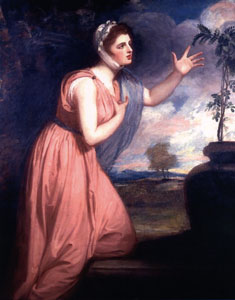
Sensibility by George Romney 1786
Shelley’s ideal seems to imply that the wondrous beauty of perception that we have should not be squandered by the fact that we live but short, unimportant lives only to be soon forgotten. Shelley considers both perception and mortality but ends up preferring the attainable (perception) rather than wasting one’s whole life struggling against the inevitable. It appears Shelley may have taken Spenser’s advice.
Finally, Rekdal’s “A Small, Soul-Colored Thing” (similar to the Raymond Carver story in title, if little else) is a complete break from traditional form. It’s also a highly narrative poem, and relies much on the use of stark visual imagery. The poem is a confused delve into delirium which results in the brief conjuration of the unconscious, Eden-like state of being before crashing back into the reality of humanity. In this way, it hearkens to Keats’ “Ode to a Nightingale” as when the speaker of that poem “sobers up” and is brought back to the land of mortals. “A Small, Soul-Colored Thing” addresses the “extreme self—consciousness, language and meaning—” which is a string of problems that “affects and shapes human identities, but not animal ones.” (2) Rekdal is, like Shelley, looking to the natural world for the eternal and not so heavily relying on humankind’s ability to create forever for itself.
Whether focusing on the perception of humans against nature or the godlike struggle against mortality, poets use idealism as a way to combat meaninglessness. We’ve seen, through the centuries, the transfiguration of immortality to a thing that is more secular, and therefore closer at hand and more easily observable. It may remain unobtainable, but poets will continue describing the human problem with ever-accruing exactitude.
Resources
(1) https://community.dur.ac.uk/kaleidoscope/index.php/kaleidoscope/article/download/30/30 [pdf]
Image source

No comments:
Post a Comment