Kevin Gallagher
Professor Porter
ENGL 4420
Final Project
In the thread I
created, I tried to cluster all the poems in which a sense hierarchic scaling
can be observed via form, comparison, and order/location of content. By scaling
I mean, as the OED defines, “the
measurement or estimation of quantities. … measurement or grading of
attributes,” and further “to measure or represent… according to an arbitrary
defined scale,” (OED online). I think the poems I’ve selected deal with reconfiguring
(assignment and assessment of) the value of various nouns within scales of size,
location and power. In a way this blogpost will operate similar to the notion of
fractal dimension, which is a ratio that compares how details in pattern (though
generally speaking of fractal patterns) changes with the scale it is measured
in. This isn’t to be confused with fractal poetry though. The sense of scaling
and ordering of nouns creates a sort of hierarchy, in which the scaling method
used to describe a noun is suggestive of not just its location, geographically,
but location in a hierarchy, and thus its value. The scaling that occurs seems
to function in two modes: micro and macro. Micro means scaling things narrowly,
or with great specificity/definition, while macro scales things in very
generalize, grand terms. In some cases poems may stick to one mode or alter
between the two, but the mode doesn’t suggest value, only the location in the hierarchy
does. I think writing about nature spontaneously
evokes scaling, as nature contains an incomprehensively wide range of size:

|
Probably the first poem I thought of
when considering hierarchic scaling was Feld’s “Little Viral Song.” I
originally thought of this poem because the poem’s scale can be thought of geographically,
on the macro scale:
“So the
sad pile of chicken flesh
In West
Timor and Bangladesh
Gave us
that certain, sad frisson
One
feels near the apocalypse.”
The use
of specific locations primarily operates as a “far away,” and foreign/alien; tts
‘sad chicken’ a reflection of how we perceive their state of living as less
civilized than our own. The poem continues to create a sense of distance/difference
in the second stanza:
“As the
infection zeros in
From
the East, one feels jaundiced.
The end
would come from that direction.”
The
certainty of the East as the source of the seemingly apocalyptic virus reinforces
the westerner’s attitude, privileging his surroundings over the East’s. Scaling
the East on the macro level, creates a hierarchy of location, and considering
the distance created, the East seems to sit near the bottom of the hierarchy
while, as we’ll seen in the following stanzas, the more localized setting of
the speaker is placed much higher, in that it is favored and less abstract, I
think this is ultimately reflective of the west’s jingoist values, as further
implied by the third stanza, which continues:
“The
end will come from that direction
One is
already inclined
Toward.
In suburban Maryland,
The
epicenter of my mind,
The
die-off of the crows and ravens
Made me
think: even here? in Kensington?”
Here
the scaling is made a bit more micro, away from the East, specifically locating
the setting in Kensington, favored in that is “the epicenter of my mind,” and that
he questions if such a virus could even make it there. In regards to the
hierarchy established, Kensington is at the top, while the further away you get
from Kensington the lower it gets.
However
it is in the fourth and fifth stanza that the hierarchy is revealed to be built
around the self of the speaker, in that he privileges what is closest to him,
stating:
“And
even here in Washington
State,
we watch them shivering
…
So long
the great winged migration”
and
later in the fifth stanza:
“So
long the great winged migration:
Now
harbinger, instead
Of
spectacle of the world’s renewal.
What
should the likes of us do,
Crawling
between toilet and bed?
And
there are other worse, symptoms.”
Relocating
the scale around the speaker and favoring the appeals of the self and
surroundings locates them as values near the top of the poem’s hierarchy which
insists our value of egocentrism. We get caught up “crawling between toilet and
bed,” more concerned for ourselves now that the virus is creating conditions that negatively affect the
values near the top of our hierarchy. When the virus was far away it was out of
mind, and no need of turning into a sensation, even the toll on birds we seem
less affected than thought of being potentially infected ourselves.
 The
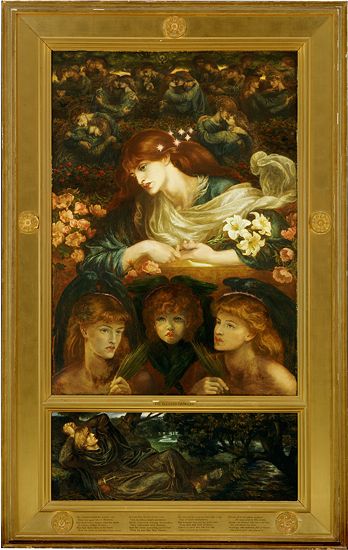
second poem I picked is Dante Gabriel Rossetti’s “The Blessed Damozel,” because
the poem shares a similar geographic scale, though the scale ranges from Earth
to Heaven. Additionally the method of creating scale can be observed in the
form as well as the content of the poem. The poem initiates the scale in the
very first stanza, locating the damozel in Heaven:
“The
blessed damozel lean’d out
From
the gold bar of heaven”
Meter wise,
(the second stanza being an exception) the poem maintains iambic trimeter on
the first, third, and fifth line of every stanza. The poem’s only regular rhyme
scheme is according to vowel sound on every second, fourth, and sixth line of
each stanza.
|
Scaling,
as a means of measurement can also create a sense of distance. I think the
distance that Rossetti wanted to emphasize between Heaven and Earth is insisted
by the difference in construction of the alternating lines. Though, considering
lines 1-2, 3-4, 11-12, 13-14, 21-22, Rossetti uses enjambment to establish a
connection between the alternating lines. In doing so, I don’t think that the
speaker is favoring Heaven or Earth; which is interesting because as paradise,
Heaven is one of the ultimate concerns of a Christian’s faith, it’s strange to
not privilege Heaven over Earth. Though I do believe the damozel is favored, or
rather her appearance is, being that the enjambed lines of the first four
stanzas are all about describing the damozel beautifully, for example lines 3-4
and 11-12 respectively: “Her eyes were deeper than the depth / Of waters still’d
at even;” and “Her hair that lay along her back / Was yellow like ripe corn.”
and etc.
The third poem I picked, offers the most obvious sense of hierarchy and scale, that being Milton’s Paradise Lost, and its clear distinctions of Heaven, Earth and Hell, ranked accordingly. In the selections from book 4 that we read, Satan pines for the top tier of Heaven and approaches paradise. The depictions of paradise are clearly preferred, being described as a “circling row / Of goodliest trees loaden with fairest fruit” (lines 147-148). Clean air and “perfumes” emanate from the garden. Eden is clearly the closest thing to Heaven on Earth as possible; the distinction is made clearer by the overgrown thicket that protects the garden.
“Yet
higher then thir tops
The
verdurous wall of paradise up sprung:
Which
to our general Sire gave prospect large
Into
his neather Empire neighbouring round.”
The garden is valued so much that it is
guarded so heavily and highly from the rest of Earth, and especially Hell. The
fact that Satan must breach the garden further insists the distance of Hell and
Heaven, and conflating the bottom of the hierarchy with top presents a problem.
According to Kristin McColgan in Abundant
Gifts: Hie http://www.rossettiarchive.org/img/s244.fogg.jpgrarchy
and Reciprocity in “Paradise Lost,” states that
Milton “envisions a universe based on … hierarchy, that according to John T.
Shawcross, ‘has allowed [Milton] to be a spokesperson for… diametrically
opposing causes” (76). Though, generally for the rest of the book hierarchy of
gender dynamics is what is what mostly observed.
I think
the distinction of differences, whether by distance, concept, or form, help
construct a hierarchy of values that reveal conditions or certain aspect of the
poems that are preferred or privileged over others. The distinction of
differences are made by establishing a scale that allows measurements to be
made that provide locations to place in the hierarchy that ultimately determine
values. These scales arbitrarily applied according to the content of the poem,
but provide new lenses to for perception.
references:
Abundant
Gifts: Hierarchy and Reciprocity in "Paradise Lost"
Kristin
Pruitt McColgan
South
Central Review http://www.jstor.org/stable/3190269
"scale, v.3." OED Online. Oxford
University Press, March 2015. Web. 13 May 2015.
Levere, Trevor Harvey. Poetry Realized in Nature:
Samuel Taylor Coleridge and Early Nineteenth-century Science. Cambridge:
Cambridge UP, 1981. Print.

No comments:
Post a Comment